Ethernet overview
Review Ethernet’s IEEE 802.3 family, wired networking role, supported media, Power over Ethernet capability, common devices, and current place in network infrastructure.
| Standard family | IEEE 802.3 Ethernet |
|---|---|
| Primary purpose | Wired local, access, and metropolitan networking |
| Data | Yes |
| Physical media | Twisted-pair copper, fiber, backplanes, and other media defined for specific Ethernet PHYs |
| Power | Power over Ethernet is supported by selected twisted-pair Ethernet types and compatible equipment |
| Typical devices | Computers, routers, switches, access points, servers, cameras, and network appliances |
| Current status | Current core wired networking standard family |
Sources: IEEE 802.3 Ethernet.
Ethernet comparison to USB
Compare Ethernet with USB for network topology, direct peripherals, cabling, power, adapters, and the different roles of a LAN connection and a host-to-device bus.
| Factor | Ethernet | USB |
|---|---|---|
| Primary role | Network connectivity among multiple systems and infrastructure devices | Direct peripherals, data, charging, and supported display connections |
| Connection model | Network links through switches, routers, or direct Ethernet connections | Typically a direct host-to-device connection |
| Cabling | Designed for structured network links over defined copper or fiber media | Designed for relatively short peripheral and device cables |
| Power | PoE can power compatible network devices over selected twisted-pair links | USB can power and charge compatible directly connected devices |
| USB relationship | USB-to-Ethernet adapters add an Ethernet network interface to a USB host | Acts as the local host connection for many external Ethernet adapters |
| Best fit | Reliable wired networking, infrastructure, servers, NAS, cameras, and access points | Local peripherals, storage, charging, and direct device connectivity |
Sources: IEEE 802.3 Ethernet and USB-IF USB4.
Ethernet use cases
See where Ethernet is the stronger choice for desktops, network storage, infrastructure, cameras, and access points, and where USB or Wi-Fi is more convenient.
| Use case | Why Ethernet fits | Better modern option |
|---|---|---|
| Desktop networking | Provides a stable wired LAN connection without relying on radio coverage | Ethernet remains a strong choice; Wi-Fi is more convenient when wiring is impractical |
| Servers and NAS | Designed for persistent network access from multiple clients | Ethernet remains the normal choice; faster Ethernet variants may be appropriate |
| Cameras and access points | Selected Ethernet links can carry both network data and PoE power | PoE Ethernet is often preferable when compatible cabling and equipment are available |
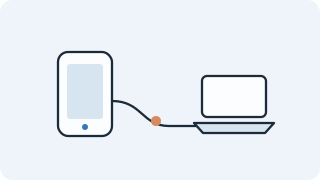
| Laptop without Ethernet | A wired LAN can still be added when needed | USB-C or USB-A Ethernet adapter |
| Single local peripheral | Ethernet may be unnecessary if no network sharing is required | USB is usually simpler for a directly attached peripheral |
Sources: IEEE 802.3 Ethernet.
Ethernet articles
Explore guides about USB and Ethernet adapters, networking hardware, router USB ports, connection speeds, and practical wired-network compatibility.